How Blackjack Probability Numbers Translate Into Odds at the Table
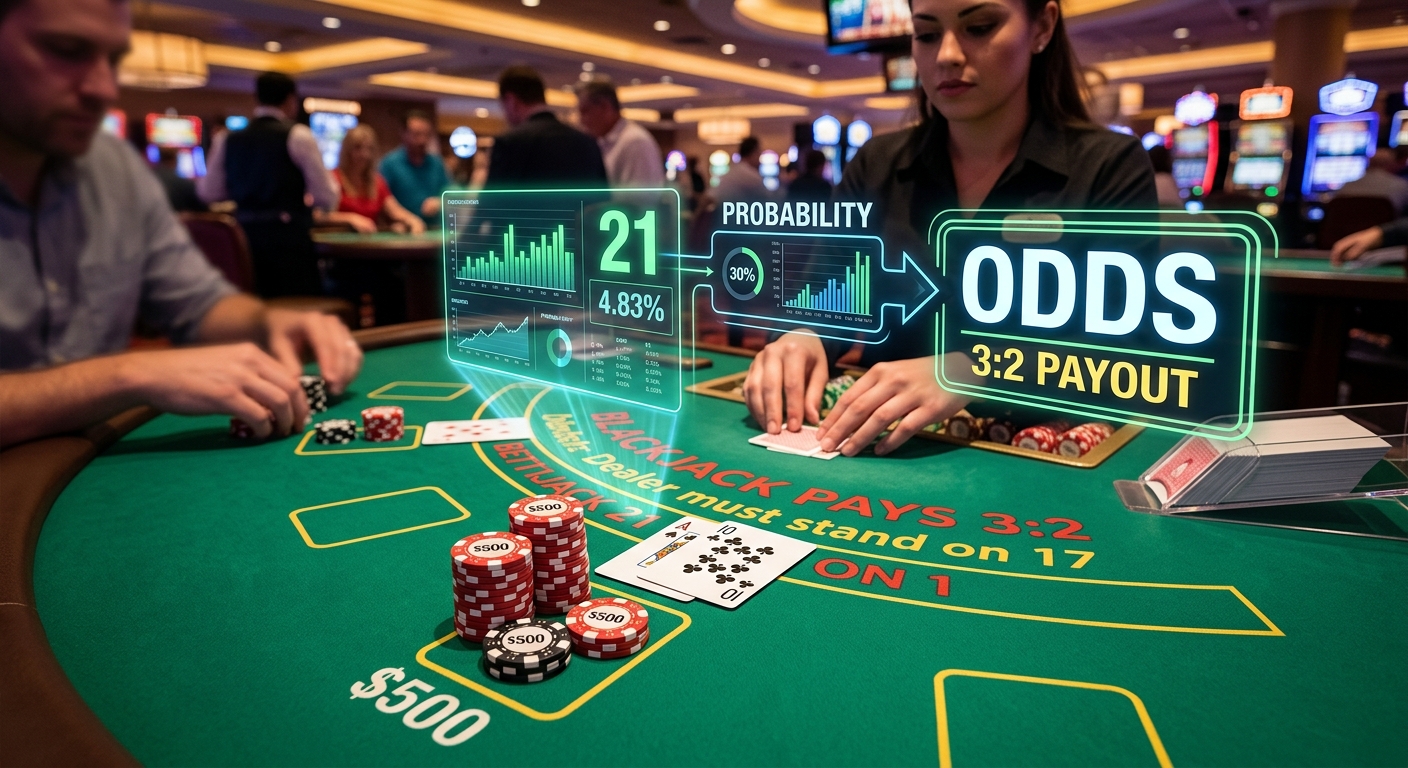
Numbers in blackjack strategy guides are exact. A 7.47% hit frequency or a 16% dealer bust rate reflects the output of millions of simulated hands. The problem is that those figures arrive in percentage form, and casinos express payouts as ratios. A table might say "pays 11 to 1" or "pays 3 to 2." Two formats, two languages, one comparison you need to make to understand where your money is actually going.
Converting probability figures into odds is the practical skill that bridges that gap. Once you can do the conversion, any number from any strategy guide becomes something you can hold directly against a casino payout. You stop guessing and start seeing the math for what it is.
The Conversion at a Glance
Converting probabilities into odds ratios is what lets you hold any strategy guide figure directly against a casino payout and see the gap in plain numbers.
- The formula: divide the percentage by 100, subtract that decimal from 1, then divide the result by the decimal to get true odds against.
- Any payout lower than the true odds reveals precisely where the house edge is built into the bet structure.
- Most blackjack side bets pay significantly below their true odds, which is the core mathematical reason basic-strategy players avoid them.
Why Strategy Guides and Casino Payouts Speak Different Languages
Blackjack strategy guides are built from probability simulations. A computer cycles through tens of millions of possible hand combinations and records outcomes. The result is a percentage: this event happens 7.47% of the time, that one happens 43% of the time. Percentages are a natural output of that kind of analysis.
Casinos set payouts as ratios because that is how betting works physically. You put a chip down. If the bet wins, the dealer pays you a fixed multiple of that chip. The payout is set in advance: 11 to 1, or 6 to 5, or 3 to 2.
Those two formats represent the same underlying math, but they look nothing alike when placed next to each other on paper. That visual mismatch is genuinely useful to casinos. It makes it hard to see at a glance whether a payout is fair or quietly skimmed. Closing that gap is a matter of one simple formula.
The Core Conversion Formula
To turn any probability percentage into odds, the process has three parts. Start with your percentage. Divide by 100 to get a decimal. Then apply this relationship:
Odds against = (1 minus the decimal) divided by the decimal
Using the pair side bet's 7.47% hit frequency as a concrete example:
Convert to decimal: 7.47 divided by 100 equals 0.0747.
Find the losing probability: 1 minus 0.0747 equals 0.9253.
Calculate odds: 0.9253 divided by 0.0747 equals approximately 12.39.
True odds against hitting a pair: roughly 12.4 to 1.
Now compare that to the casino's payout. If the table pays 11 to 1 on a pair, the gap between 12.4 and 11 is the house edge, sitting right there in plain arithmetic. The casino expects you to win once every 13.4 attempts. It pays you as if you were expected to win once every 12 attempts. That difference accumulates across every hand played.
Running This on Any Figure
The method works on any probability figure from any source. Here is the process in a clear sequence:
- Locate the stated probability or hit frequency in your strategy guide, expressed as a percentage.
- Divide that number by 100 to convert it to a decimal.
- Subtract the decimal from 1 to find the probability of the bet not hitting.
- Divide that result by the original decimal from step 2.
- Read the answer as "X to 1 against," meaning the bet hits once for every X times it misses on average.
Players who want to run these calculations without grinding through the division each time can use an odds converter to get the result instantly. That makes it practical to check any figure you encounter in a strategy guide before you ever sit down at a table.
Applying the Method to the 21+3 Side Bet
The 21+3 side bet appears on most modern multi-deck tables. Your two hole cards combine with the dealer's upcard to form a three-card poker hand. Suited trips, straight flushes, three of a kind, straights, and flushes all pay out. Across all qualifying hand categories, the overall hit frequency sits at roughly 32%, though the exact figure shifts with deck count and rule variations.
Run the conversion: 32 divided by 100 equals 0.32. Subtract: 1 minus 0.32 equals 0.68. Divide: 0.68 divided by 0.32 equals 2.125. True odds against: about 2.1 to 1. The bet hits roughly once every three hands on average.
A bet that hits once every three attempts might sound like a good deal at 2 to 1. But the casino does not pay a flat 2 to 1. It pays tiered amounts by hand rank, reserving the highest payouts for the rarest qualifying hands. Suited trips might pay 100 to 1 while a basic flush pays only 5 to 1. The weighted average payout across all winning hands consistently falls short of the true 2.1 to 1 fair value. Depending on the variant, the house edge on 21+3 lands anywhere from roughly 3.2% to over 13%. Players using correct basic strategy on the main hand face a house edge of around 0.5% under favorable conditions. That comparison makes the tradeoff clear.
Lucky Lucky and the Allure of Tiered Payouts
The Lucky Lucky side bet pays when your two cards and the dealer's upcard total 19, 20, or 21. The pay table is layered: suited 7-7-7 might pay 200 to 1, while an unsuited 6-7-8 might pay only 3 to 1. Those large numbers at the top of the scale anchor your attention on the rare outcomes.
The reality is that most Lucky Lucky wins come from the lower-paying combinations, which occur more often but pay at ratios well below their true odds. Run the conversion on any individual combination and the same pattern appears: the casino's payout falls short of what the true probability of that combination hitting would justify. Across all outcomes combined, the house edge typically lands between 2.5% and 5%.
The tiered structure is effective by design. A 200 to 1 payout sounds exceptional. But that payout applies to an event whose true odds sit far above 200 to 1. The frequent, low-paying wins carry the volume, and those wins are consistently underpaid relative to their probability. The headline number on the felt is real. The implied fairness of the overall bet is not.
What the Three Side Bets Reveal Side by Side
Running the conversion across these common bets produces a consistent picture each time:
- Pair side bet at 7.47%: true odds of roughly 12.4 to 1, standard casino payout of 11 to 1, effective house edge well above 11%.
- 21+3 side bet at approximately 32% overall: true odds near 2.1 to 1, weighted average payout below that benchmark, house edge from 3.2% to above 13% depending on variant.
- Lucky Lucky side bet: a tiered pay table with headline-grabbing top payouts and a blended house edge of 2.5% to 5% across all outcomes.
These are not anomalies. The gap between true odds and posted payouts is a structural feature of side bets. Every casino game rests on gambling mathematics: the payout for each outcome is set slightly below the probability-adjusted fair value, and the cumulative shortfall becomes the house's margin over time.
Basic strategy does not eliminate the house margin on the main hand. It reduces it to around 0.5% under favorable rule conditions. That is the best available number for a player who is not counting cards. Side bets pull chips away from that low-edge position and redirect them into bets where the edge is four, ten, or twenty times higher depending on the specific offering and the variant being played.
The Numbers Make Every Side Bet Readable Before You Place It
The conversion method is not just a post-game analysis tool. Strategy guides for every major blackjack variant are widely available, and they publish hit frequencies and probabilities for the side bets at the tables you are about to play. Run the numbers at home. Convert the percentages. Compare the results against the posted payouts.
When you do that work in advance, every side bet circle on the felt becomes transparent before any money changes hands. You can see that the pair circle pays 11 to 1 on a 12.4 to 1 shot. You can see that the 21+3 spot pays tiered rates averaging out below 2.1 to 1. You can see that Lucky Lucky returns 3 to 1 on combinations whose true odds sit above that figure.
That visibility does not forbid placing a side bet. It means you place it knowing the exact cost. For players working to build their understanding of blackjack strategy, that kind of clarity has real value. Every chip on the main hand played at correct basic strategy operates at the lowest house edge available to a recreational player. Every chip moved to a side bet works at a meaningfully higher edge. The probability-to-odds conversion is the tool that makes that cost visible in plain numbers, every single time you need it.