Play Vegas Strip Blackjack
The Las Vegas casino ruleset - four decks, liberal splitting, 3:2.Vegas Strip Blackjack is free to play right here with no download, no signup and no real-money risk - you start every session with 1,000 play chips. The Las Vegas casino ruleset - four decks, liberal splitting, 3:2. It is dealt from 4 decks, blackjack pays 3:2, and a basic-strategy player faces a house edge of about ~0.35% with basic strategy.
Vegas Strip Blackjack recreates the generous rules once found on the famous Las Vegas Strip. It is dealt from four decks, the dealer stands on all 17s including soft 17, and you may double down on any two cards, double after splitting, and split most pairs up to four hands. The dealer also peeks for blackjack under a ten or Ace, so you never lose a split or double to a natural you could not see coming. Those liberal rules make Vegas Strip one of the lowest-edge blackjack games available, a touch friendlier than the six-deck standard. The trade-off is subtle: with the dealer standing on soft 17 and shallow four-deck penetration, correct play barely differs from classic basic strategy, so it is an ideal table for a confident player who wants the best realistic odds without learning a whole new chart.
How to Play Vegas Strip Blackjack
In a nutshell: The Las Vegas casino ruleset - four decks, liberal splitting, 3:2. It is dealt from 4 decks (208 cards), blackjack pays 3:2, and the house edge is about ~0.35% with basic strategy.
The rules of Vegas Strip at a glance
| Dealer rule | Stands on all 17s (including soft 17) |
|---|---|
| Decks | 4 standard 52-card decks |
| Blackjack pays | 3:2 |
| Double down | Any two cards; double after split allowed |
| Split | Most pairs to 4 hands; split Aces get one card each |
| Dealer peek | Yes, under a 10 or Ace |
| House edge | ~0.35% with basic strategy |
| Difficulty | Player-friendly rules |
| Family | Classic |
Step by step
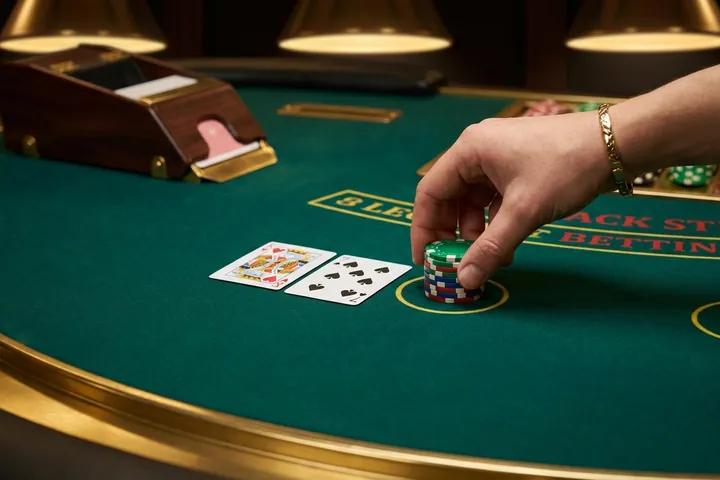
Objective
Beat the dealer by finishing with a total nearer 21 without busting. Ten-value cards and Aces make up the natural blackjack that pays 3:2 here.

Four-deck deal
Cards come from a four-deck shoe. You receive two face-up cards; the dealer takes one up-card and one hole card and peeks for blackjack under a 10 or Ace.
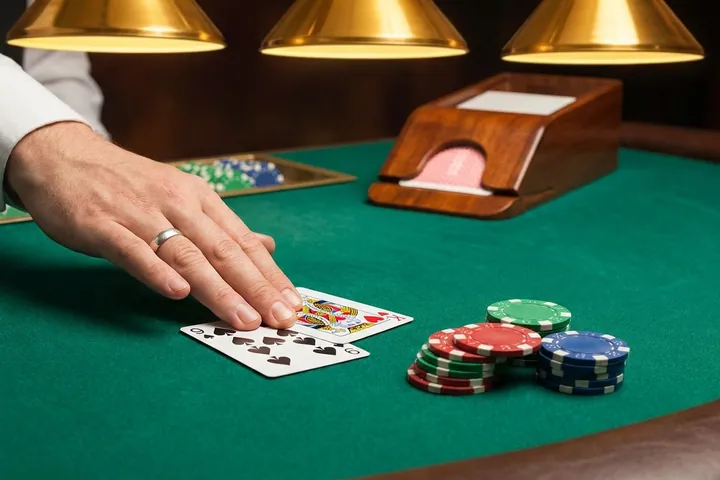
Act on your hand
Hit, stand, or double down on any two cards. The generous doubling rules are the heart of the Vegas Strip advantage, so use them on strong totals.
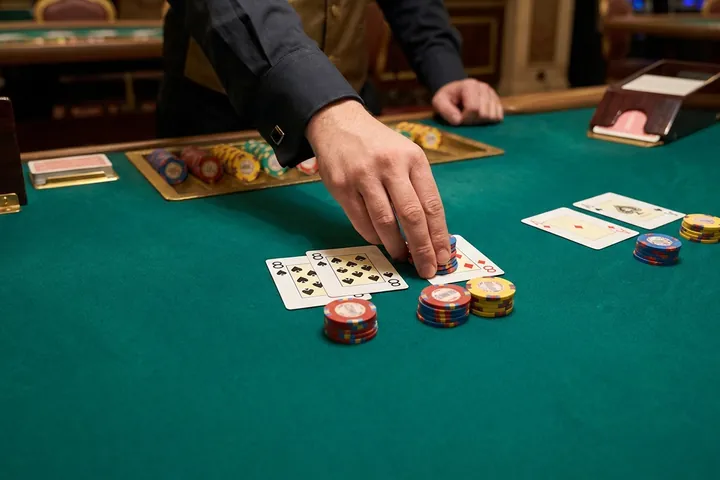
Split and re-split
Split any pair up to four hands and double after splitting. Aces may be split but receive only one card each, the standard restriction.

Dealer stands on 17
The dealer draws to 17 and stands on every 17, soft or hard. Standing on soft 17 is the rule that keeps this game's house edge so low.
The story behind Vegas Strip
The “Vegas Strip” name comes from a real distinction that mattered to players in twentieth-century Las Vegas. The big resort casinos lining the Strip and the older gambling halls downtown ran slightly different blackjack rules, and knowledgeable gamblers learned to prefer one over the other.
Strip rules were the more generous set: four or two decks, the dealer standing on soft 17, and liberal doubling and splitting. Downtown casinos more often made the dealer hit soft 17, squeezing a little extra edge from the house. As card-counting fame drove more scrutiny in the 1960s and 70s, both rulesets tightened, but the Strip version remained the benchmark for a fair, player-friendly game.
Digital blackjack adopted “Vegas Strip Blackjack” as a recognizable brand for exactly those liberal rules, preserving the four-deck, stand-on-soft-17 game as a distinct offering. It endures because it delivers what its name always promised - the closest thing to the golden-age Las Vegas table odds, without the smoke or the plane ticket.
Winning Vegas Strip strategy
💡 Top tip: Use standard basic strategy almost unchanged - Vegas Strip's stand-on-soft-17, four-deck rules are exactly what most basic-strategy charts assume, so the “book” play is correct.
Smart plays, in order of importance
- Exploit the liberal doubling: double 9 against a dealer 3 through 6, double 10 against 2 through 9, and double 11 against everything except an Ace.
- Because double-after-split is allowed, split 2s, 3s and 7s against a dealer 2 through 7, and split 6s against 2 through 6.
- Always split Aces and 8s regardless of the dealer card, and never split 10s - a pat 20 is too strong to break up.
- Stand on hard 12 against a dealer 4, 5 or 6, but hit 12 against a 2 or 3, a small distinction that basic strategy nails.
- Skip insurance and even money here just as everywhere; the four-deck count does not change the fact that it is a losing side bet.
- Keep bets flat - the low house edge is a reason to play longer and steadier, not to gamble bigger.
Advanced Vegas Strip tactics
- The dealer peek means a doubled or split bet is safe from a dealer natural, so you can double and split fearlessly against a 10 or Ace up-card when strategy calls for it.
- Four decks make the deck composition slightly more player-friendly than six or eight, marginally increasing the value of doubling and splitting into rich totals.
- Because the dealer stands on soft 17, you can stand on soft 18 versus a dealer 2 through 8 rather than doubling into a hand the dealer will not improve.
- Track your four-hand split limit: against a weak dealer card, re-splitting a third and fourth pair of 8s or Aces extracts extra value from a good situation.
- Never deviate toward “table feel” - Vegas Strip's low edge only holds if every marginal 12, 16 and soft 18 is played by the book.
- Treat doubling on soft hands as a bet-more-when-favored tool: doubling soft 13-18 against a dealer 4, 5 or 6 wins chips precisely when the dealer is weakest.
- Set a stop-win as well as a stop-loss; the flatter variance of a low-edge game makes it easy to grind for hours, so decide in advance when a good session ends.
Common Vegas Strip mistakes to avoid
- Not using the liberal doubling rules - Vegas Strip lets you double freely and after splits, so failing to double 9, 10 and 11 in the right spots leaves value on the table.
- Splitting 10s because two hands feels better - a pat 20 is already a near-certain winner and should never be broken up.
- Assuming the dealer hits soft 17 - here the dealer stands on soft 17, so play the standard chart rather than a hits-soft-17 version.
- Taking even money on your blackjack - declining it and collecting the 3:2 payout wins more over the long run.
Vegas Strip rule variations
Downtown rules
The historic counterpart to Strip rules, most often played with two decks and the dealer hitting soft 17, giving the house a slightly larger edge in exchange for deeper single- and double-deck games.
Two-deck Strip
A tighter version dealt from two decks rather than four, which lowers the edge further on paper but is rarer and often comes with other restrictions.
Re-split Aces
Some Strip tables allow re-splitting Aces or drawing more than one card to split Aces, a rare and valuable bonus that reduces the house edge a little more.
Six-deck Strip
A modern compromise that keeps the stand-on-soft-17 and liberal double/split rules but uses six decks, trading a sliver of edge for a longer shoe.
Surrender add-on
A few Strip-rule tables layer late surrender on top, letting you fold hard 15 and 16 against strong dealer cards for a further tiny improvement.
Vegas Strip questions and answers
What makes Vegas Strip rules special?
Vegas Strip combines a four-deck shoe, the dealer standing on all 17s, doubling on any two cards, doubling after splits, and splitting to four hands. That bundle of player-friendly rules gives it one of the lowest house edges in mainstream blackjack.
Does the dealer hit soft 17 in Vegas Strip?
No. The classic Vegas Strip rule is that the dealer stands on soft 17 (Ace-6), which is the more favorable version for the player and the assumption behind most printed basic-strategy charts.
How many decks are used?
Four standard 52-card decks. That is fewer than the six or eight decks common elsewhere, and fewer decks nudge the odds slightly in the player's favor.
Can I double after splitting?
Yes. Double-after-split is permitted, which is a meaningful bonus. It makes several pair splits correct - such as splitting low pairs against a weak dealer card and then doubling the resulting strong two-card totals.
How many times can I split?
You can split most pairs up to four hands. Aces are the exception: you may split them but each Ace receives only one additional card, so you cannot draw a long hand off a split Ace.
Does the dealer check for blackjack?
Yes. The dealer peeks at the hole card for a natural when showing a 10 or an Ace. If the dealer has blackjack the hand ends immediately, so you never lose extra chips from a double or split against a hidden natural.
Is the strategy different from Classic Blackjack?
Barely. Because Vegas Strip uses the stand-on-soft-17 rules that standard charts assume, the correct plays are nearly identical to Classic. The main practical difference is that the liberal doubling and splitting rules let you press your advantage more often.
What is the house edge?
With perfect basic strategy the edge is roughly 0.35%, a shade lower than the six-deck classic game. It is among the best odds you will find at any blackjack table.
Why is it called Vegas Strip?
The name refers to the ruleset that was standard at the large casinos along the Las Vegas Strip, as distinct from the tighter “Downtown” rules that had the dealer hit soft 17. The Strip version was the more generous of the two.
Should I take even money on my blackjack?
No. Even money is just insurance on your own natural. Declining it and taking the 3:2 payout wins more over time, because the dealer will not have a matching blackjack often enough to justify locking in the smaller sure thing.
Vegas Strip guides & strategy
- Basic strategy for stand-on-soft-17 games
- Blackjack house edge, explained
- The complete blackjack basic-strategy guide
Still have a question about Vegas Strip Blackjack? Browse the full blackjack FAQ, look up a term like classic or house edge in the blackjack glossary, or compare Vegas Strip with the other games in the rules for every blackjack variant.
Last updated .