How Blackjack's House Edge Compares to Craps, Roulette, and Slots
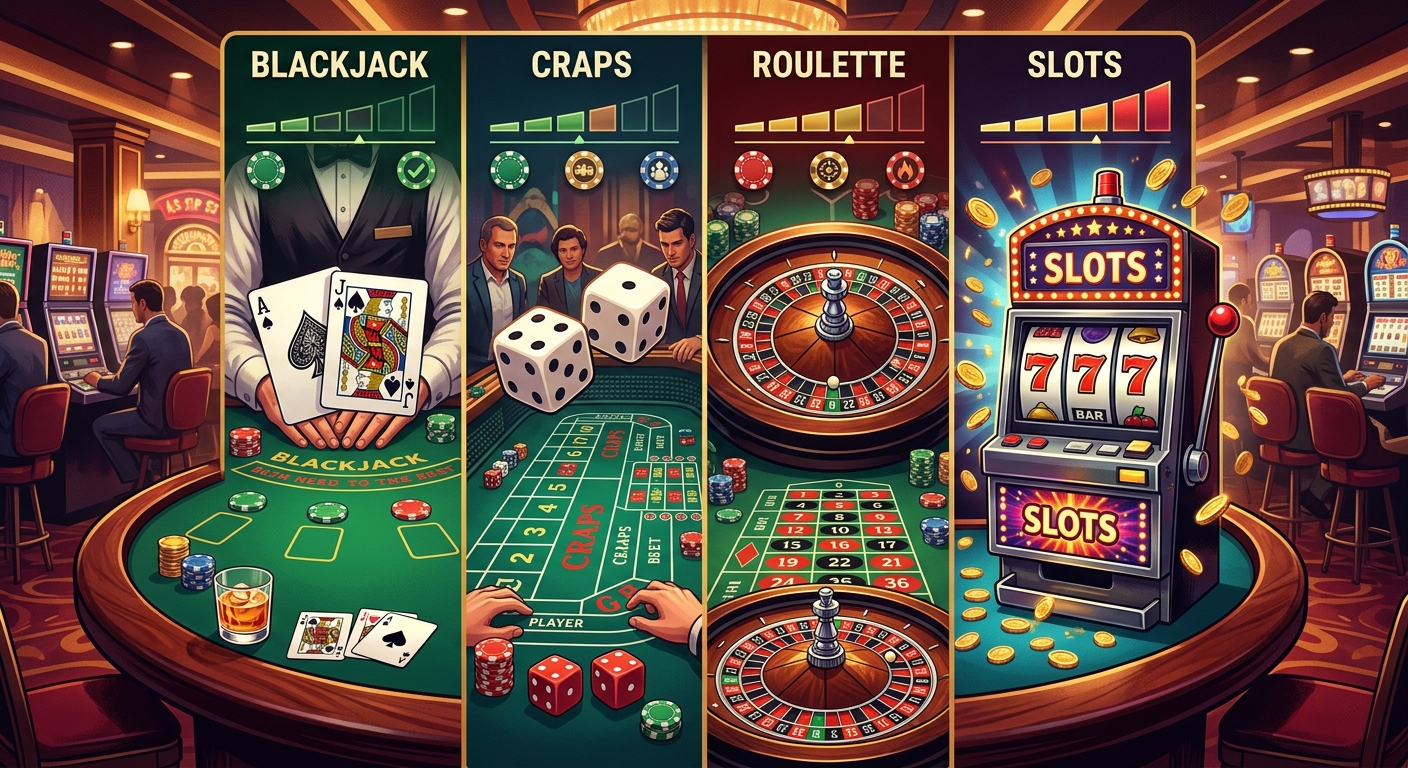
The casino floor looks like a democracy of games. Lights everywhere, sounds from every direction, and dozens of ways to bet. But not every game treats your money the same way. Behind every table and every machine sits a number. That number is the house edge, and it determines how much of your money the casino expects to keep over time. Get that number wrong, and you are paying a premium for entertainment without knowing it. Get it right, and you play with your eyes open.
The numbers behind the games tell a story that intuition never could.
- Blackjack's house edge drops to roughly 0.5% when you apply correct basic strategy, placing it among the lowest edges in the casino.
- Craps matches blackjack on its two best bets, but the table is full of traps with far worse odds , bet selection is everything.
- Roulette and slots carry significantly higher edges that no decision-making can reduce, because neither game rewards player choices with better math.
What the House Edge Actually Means
The house edge is expressed as a percentage of each bet the casino expects to keep over many thousands of rounds. It is not what happens on any single hand. You can win a session at roulette and lose three at blackjack. That is variance. The house edge operates over the long run, quietly shifting the math in the casino's favor.
If a game carries a 5% house edge, the casino expects to return $95 for every $100 wagered over time. That does not mean you lose $5 on every single bet. It means the average loss across thousands of rounds trends toward that figure. The lower the house edge, the longer your money lasts and the more value you extract from each session.
This is why understanding the house edge for the games you play is not optional knowledge for a deliberate player. It is the baseline.
Blackjack's Edge Is the One You Can Actually Control
Blackjack is unusual among casino games because its house edge is not fixed. It depends entirely on how you play. A player making random decisions faces a house edge of roughly 2% to 4% depending on the rule set. A player applying correct basic strategy brings that number down to approximately 0.5% in a standard six-deck game with favorable conditions.
That gap from 4% down to 0.5% is entirely the result of decisions. Hit or stand. Double down or not. Split the pair or play the hand as one. Every correct decision chips away at the casino's expected return. No other common table game offers that kind of player-driven reduction.
Several rule variations affect where that edge ultimately lands:
- Blackjack payout structure: A 6:5 payout on a natural blackjack adds roughly 1.4% to the house edge compared to the standard 3:2 return.
- Number of decks in play: Single-deck games carry lower edges than six- or eight-deck shoes, all else being equal.
- Dealer action on soft 17: When the dealer hits soft 17, the house edge increases by about 0.2% over a dealer that stands.
- Doubling restrictions: Games that limit doubling down to specific hard totals cost the player roughly 0.25% compared to unrestricted doubling rules.
Published research on casino game mathematics confirms what basic strategy charts have demonstrated for decades: blackjack rewards correct play in ways no purely chance-based game can replicate. According to work catalogued by the UNLV Center for Gaming Research, blackjack generates more strategic literature than any other table game precisely because player decisions genuinely shift the mathematical outcome over time.
Craps: Excellent Odds If You Know Where to Look
Craps has a reputation as the wildest table in the casino. Loud, fast, and intimidating for newcomers. That reputation masks the fact that two of its bets sit comfortably alongside blackjack in terms of house edge.
The pass line bet carries a house edge of 1.41%. The come bet matches that number exactly. Add free odds behind the pass line and the blended edge drops even further, because odds bets carry zero house advantage. Some casinos allow odds multiples of 3x, 4x, or even 10x, which can reduce the effective edge on the combined wager to well below 1%.
The problem is the layout itself. Craps features dozens of betting options, and most of them carry terrible odds. Proposition bets in the center of the table run at house edges of 11% to 16%. The "any seven" bet sits at 16.67%. These options exist to lure players away from the two or three genuinely strong bets the game actually offers.
If you have never navigated a craps table before, seeing the mechanics in action makes the betting structure much clearer. You can play craps online to watch how pass-line and come bets resolve across a full sequence of rolls before weighing them against blackjack's more decision-heavy framework.
The critical distinction between craps and blackjack is that in craps, the low edge is locked into specific bets and does not respond to your choices after the initial wager. In blackjack, every hand gives you a live decision. That ongoing agency is what makes blackjack's edge compression unique among table games.
Roulette: Elegant, Popular, and More Expensive Than It Looks
Roulette is among the most recognizable casino games in the world. The spinning wheel, the bouncing ball, the anticipation before it settles. The experience is genuine. The math is less friendly than most players realize.
American roulette, with both a zero and a double-zero pocket, carries a house edge of 5.26% on nearly every bet available. That is roughly ten times the edge you face playing blackjack with basic strategy. European roulette removes the double-zero, bringing the edge down to 2.70%. French roulette adds the "en prison" rule, which can cut the edge on even-money bets to approximately 1.35%.
Even at its best, roulette's edge sits well above blackjack. No amount of careful decision-making changes the outcome once the ball is in the air. Your position is locked before the wheel turns. There is no equivalent of splitting a pair or doubling into a favorable count. The game resolves entirely by physics after you place the bet.
Slots: High Entertainment, Higher Edge
Slot machines are the most played games in most casinos. They are also the most expensive games to play in terms of house edge, and that edge is deliberately hidden from the player.
Most slot machines in US casinos return between 85% and 97% of all money wagered over their operating lifetime. That translates to a house edge of 3% to 15%. The specific figure varies by machine, casino, and jurisdiction, and it is almost never displayed anywhere a player can see it.
A few facts about how slot volatility and edge interact are worth keeping in mind:
- High-volatility slots may produce large jackpots on rare occasions, but their overall return to the player often does not differ meaningfully from low-volatility machines of the same denomination.
- Bonus rounds and free spins features are already factored into the published return-to-player percentage. They are not free value added on top of the base game.
- Penny slots typically carry lower return-to-player rates than dollar slots, meaning the mathematical cost per unit wagered is often higher, not lower, despite the smaller denomination.
Slots offer no in-hand decisions that affect the mathematical result. Betting maximum versus minimum may change jackpot eligibility on some machines, but it does not improve the house edge. The return percentage is fixed in the software, and no playing style changes it.
Four Common Casino Games Ranked by House Edge
| Game | Best-Case House Edge | Player Input Reduces Edge? | Notes |
|---|---|---|---|
| Blackjack (basic strategy) | ~0.5% | Yes, significantly | Requires learning and consistently applying correct strategy |
| Craps (pass line + max odds) | ~0.4% blended | Partially (bet selection only) | Most table bets carry far higher edges; discipline required |
| European or French Roulette | 1.35% to 2.70% | No | Better than American version; no strategic input changes the math |
| American Roulette | 5.26% | No | Double zero adds roughly ten times blackjack's best-case edge |
| Slots | 3% to 15% | No | Edge varies by machine; rarely disclosed to players at the floor level |
How to Think About These Numbers As a Player
The pattern in that table is not accidental. The games with the lowest edges require either knowledge (blackjack) or strict bet selection discipline (craps). The games with the highest edges require nothing of the player at all. Casinos design their floor around this spectrum intentionally.
Games that reward informed play can afford to offer better odds because the casino knows most players will not bother to learn. Games that demand nothing carry higher built-in advantages because there is no skill barrier protecting the player's bankroll. Understanding this structure is worth more than any lucky streak.
Here is a straightforward ranking of these game choices based on mathematical return alone:
- Blackjack with basic strategy , lowest achievable edge for most players; requires preparation but the math rewards the effort on every single hand.
- Craps pass line with free odds , matches or beats blackjack on raw numbers, but only if you know exactly which bets to place and which to avoid entirely.
- European or French Roulette , no strategic input available, but meaningfully better than the American version for the same entertainment experience.
- American Roulette , reasonable for recreational play, but costs roughly ten times more per dollar wagered compared to blackjack played correctly.
- Slots , a genuinely different kind of experience, but carry the highest mathematical cost of any game covered here and no decisions that change it.
None of this means you must only ever play the game with the lowest edge. Entertainment value is real. The point is that you should know exactly what you are paying for it.
Why Blackjack's Decision-Based Edge Stands Apart
Craps and blackjack are often grouped together as the smart-player games. That pairing is partially correct but misses an important distinction. In craps, the intelligent move is to place the pass line bet, take maximum odds, and then stop adding bets. You make one or two selections before the action starts, and the dice take it from there.
Blackjack is built differently. Every single hand demands a choice. Hit, stand, double, split, surrender. Each choice has a mathematically correct answer based on your cards and the dealer's upcard. The basic strategy chart encodes all of those answers. Following it consistently is what produces the 0.5% edge figure. Deviating from it is what inflates that edge back toward 2% or beyond.
This means blackjack rewards a learnable, repeatable skill in real time on every hand dealt. Craps rewards knowing where to put your chips before the dice roll. Roulette and slots reward nothing except the placement of the bet itself. These are fundamentally different relationships between the player and the underlying math.
The Math Separates the Deliberate Player From the Lucky One
Lucky runs happen in every game. A slot machine pays a massive jackpot. A craps table runs hot for forty minutes. A roulette number hits twice in a row. These moments are real, and they are memorable.
They are also not reproducible by choice. Luck is variance. It is not a strategy.
What separates a deliberate player from someone simply riding variance is knowing the underlying numbers and making decisions consistent with those numbers over time. Blackjack gives you the clearest opportunity to do exactly that. The house edge starts low. It gets lower with correct play. And the math actively responds to what you do at the table.
No other game in this comparison offers that combination. That is not a matter of opinion. It is what the numbers say.